
Creator of Name & Place
Software developer, genealogist, author, speaker
I build tools and write about structured approaches to history, helping researchers understand how people and places connect over time.
I build tools and write about structured approaches to history, helping researchers understand how people and places connect over time.
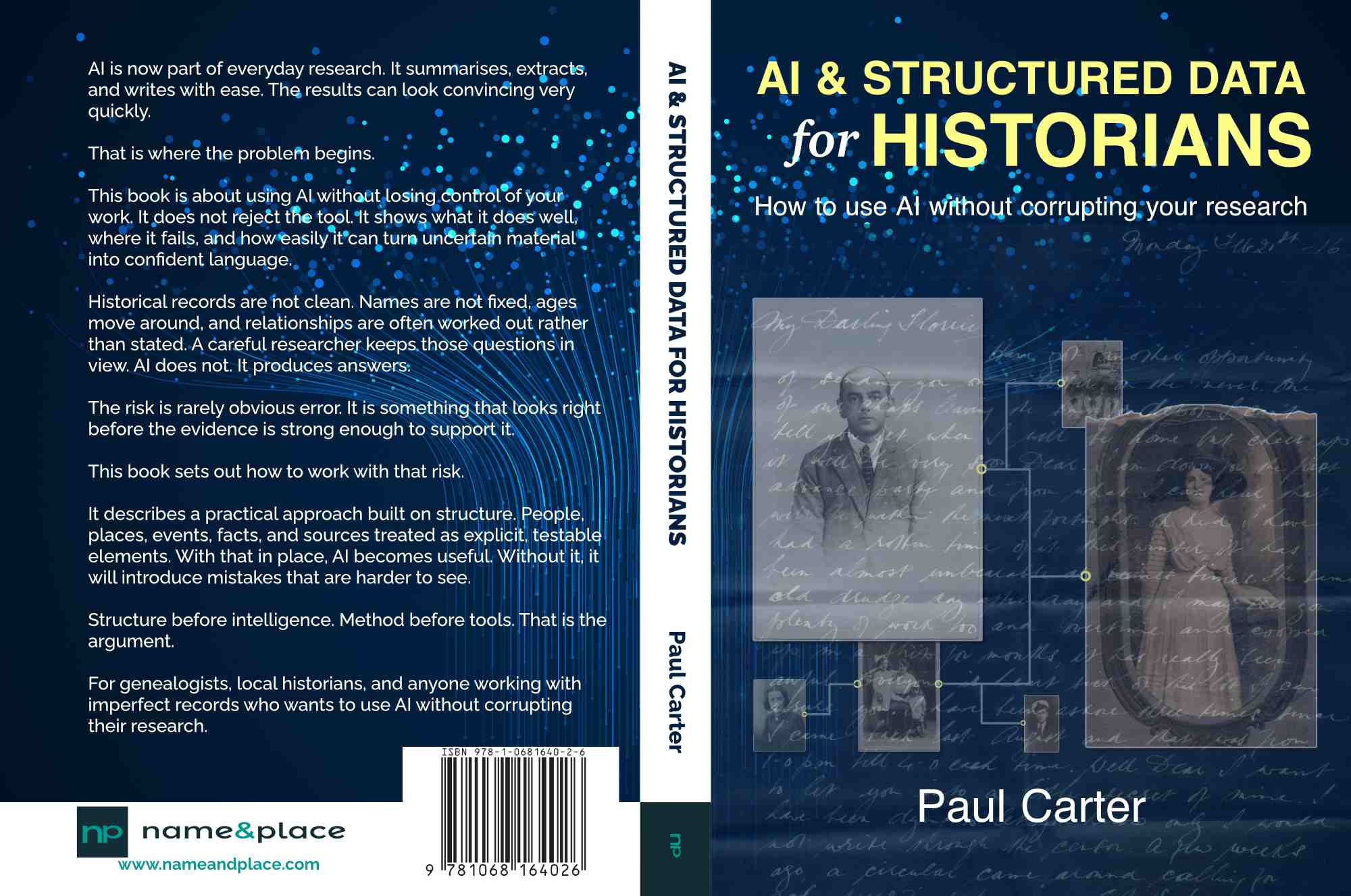
Artificial intelligence is now everywhere in historical research. It can summarise, transcribe, explain, and produce convincing answers in seconds.
That convenience is also where the danger begins.
AI systems are language tools, not evidence tools. They produce fluent output, not reliable conclusions, and they can quietly turn uncertainty into false confidence.
This book is not about chasing the latest tools. It is about learning how to use AI without allowing it to damage the quality of your research.
It explains why structured data, clear provenance, and disciplined method matter more now than ever, and how historians, genealogists, and local researchers can work with AI while keeping control of the evidence.
Good history requires inspection, not persuasion. Structure makes that possible.
What AI actually is, what it is not, and why fluency can be misleading.
Why claims, sources, people, places, and events must remain separate.
Preventing assumption creep, narrative smoothing, and false certainty.
Real ways to use AI safely in genealogy and local history work.
Available now in paperback.
£15 + Postage & Packing
Kindle and other e-book editions coming winter 2026.
A third book is already in progress, continuing the wider work around family, place, and the deeper structure of historical research.

I didn’t set out to write a book.
I was trying to make sense of my own research, and repeatedly running into the same limits. Following people through records would only get me so far before questions of place, context, and proximity started to matter more than names on a chart.
Beyond The Tree grew out of that frustration.
It’s about what happens when you stop treating a family tree as the finished product and start seeing it as one part of a much wider picture. People lived alongside others, moved through shared spaces, and were shaped by boundaries and institutions that don’t sit neatly in a diagram.
This book stems from working with records, and from noticing what starts to emerge as research grows beyond a single family line and questions of place and proximity come into view.
It explains that family trees very much have their place. It simply recognises where their structural limits start to show, and what becomes possible when you build something around them instead.
Moves past simple parent–child charts to consider households, associations, and local context.
Shows how parishes, towns, streets, and boundaries shape lives and the records they leave behind.
Offers practical ways to organise sources, evidence, and places, enabling patterns to emerge.
Written for genealogists and local historians working with real records, not theory.
Available in paperback
£15 + Postage & Packing
Kindle edition (UK) Kindle edition (US)
* Other e-book options are available. See Name & Place for details.
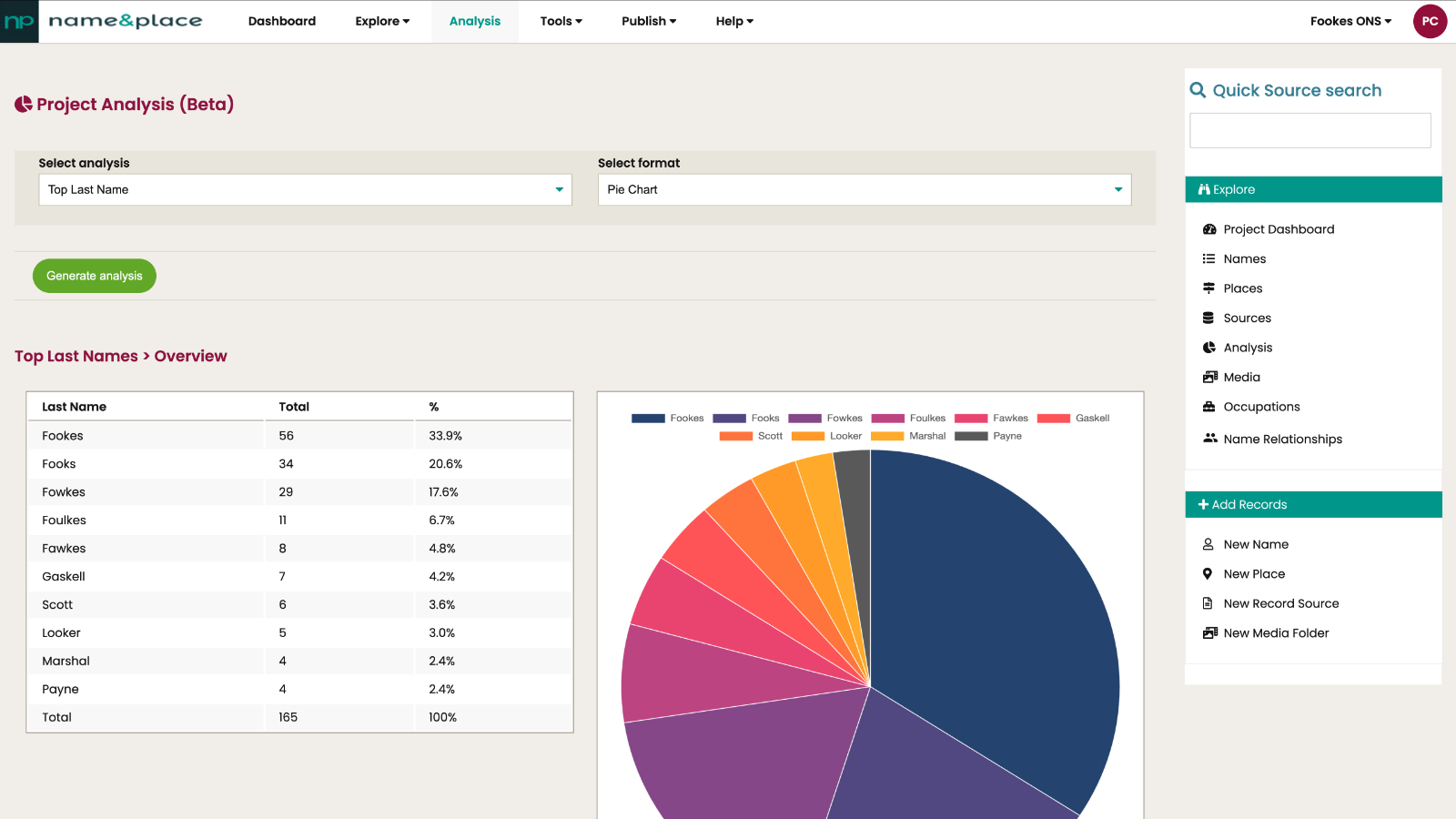
I created Name & Place because my own research kept breaking down once it grew beyond a single family. Place, context, and structure mattered, but I couldn’t find a practical way to bring people, places, and sources together without losing clarity.

I’m a software developer and genealogist, and I give talks that help family and local historians make better use of technology without needing to be technical.
My talks focus on structure, data, and emerging tools, always grounded in real historical research and real records. They’re aimed at demystifying technology and helping audiences see how it can support, rather than replace, careful historical work.
Online talks are available.
In-person talks may be possible on request.
Explores practical ways to share research online, from simple websites to structured datasets. The talk looks at the benefits and limitations of each approach, and how to choose what’s right for your project.
Places modern AI tools in historical context, explains key concepts in plain language, and considers how AI may, and may not, be useful in family and local history research.
Looks at how to organise transcribed data from larger projects, particularly within societies and voluntary groups, and how good structure enables long-term reuse and analysis.
Speaking fees are discussed on a case-by-case basis, depending on format, location, and the nature of the event. Please get in touch to discuss availability.
For enquiries about talks or availability, please use the contact form below.
Contact Paul
I’m a software developer by background, and a genealogist by inclination. Most of my work sits where technology meets historical research, building tools and ideas that try to respect the complexity of the past rather than reduce it.
I’m particularly interested in place and context, and in what records begin to show once you stop treating them in isolation. That way of thinking runs through my writing, the software I build, and the talks I give.
I spend a lot of time thinking about structure and how things will actually be used. Most of what I build is aimed at people working directly with real historical records.
If you’d like to get in touch about Name & Place, writing, or speaking, the easiest way is to send a short message below. I’ll reply when I can.